

Routing Strategies
Explore the routing strategies available in Tatum’s RPC Gateway and learn how to use them to control traffic flow across your connected RPC endpoints.
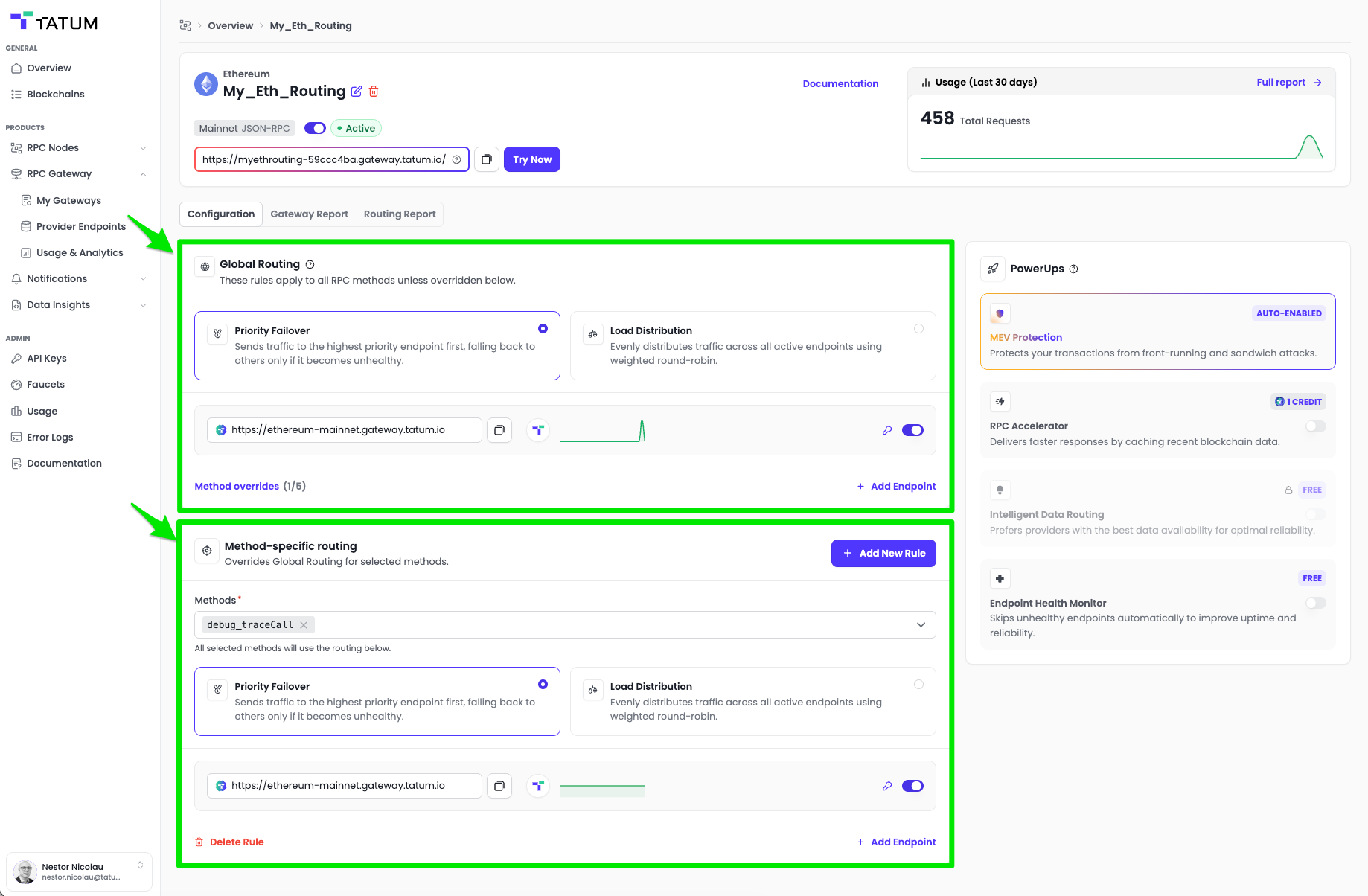
Tatum's RPC Gateway offers routing strategies that control how traffic flows across your connected RPC endpoints. You can configure routing at two levels: global (applies to all requests) and method-specific (overrides global settings for individual RPC methods).
Both levels support the same two routing strategies, plus an optional Intelligent Data Routing power up to control how traffic flows across your connected RPC endpoints, each designed for different reliability, performance, and data-freshness needs. These strategies determine which endpoint receives your requests and how the Gateway chooses between multiple providers.
Routing Levels
Global
Global Routing applies your chosen strategy to all RPC requests for a chain.
Method-Specific
Method-Specific Routing overrides the Global configuration for individual RPC methods, letting you optimize reliability, cost, or provider compatibility on a per-method basis.
Routing Strategies
Priority Failover
Priority Failover sends all traffic to your primary endpoint and automatically fails over to the next if it becomes slow, lagging, or unhealthy. Best for maximum reliability.
Load Distributed
Load Distributed spreads traffic across all active endpoints using weighted round-robin, preventing any single provider from being overloaded. Best for balanced performance across multiple providers.
How to Configure Routing in a Custom Gateway
Update Gateway
PATCH /v4/manage/gateway/{id}
Update routing in an existing gateway by using the endpointRouting parameter.
Updated 7 months ago