

Workflow
Webhooks are automated messages sent from applications when certain events occur. The Tatum webhook system lets you receive notifications about balance update events for specific addresses.
Steps
Step 1: Create an Alert
Use our Wizard to quickly set up your first notification alert
In this example, we create an alert type ADDRESS_EVENT
curl -i -X POST \
  https://api.tatum.io/v4/subscription?type=mainnet \
  -H 'Content-Type: application/json' \
  -d '{
    "type": "ADDRESS_EVENT",
    "attr": {
      "address": "0xF64E82131BE01618487Da5142fc9d289cbb60E9d",
      "chain": "ETH",
      "url": "https://<YOUR_WEBHOOK_URL>"
    }
  }'
// yarn add @tatumio/tatum
import {TatumSDK, Network, Ethereum} from '@tatumio/tatum'
const tatum = await TatumSDK.init<Ethereum>({network: Network.ETHEREUM})
const subscription = await tatum.notification.subscribe.addressEvent({
address: '0xF64E82131BE01618487Da5142fc9d289cbb60E9d', // replace with your address
url: 'https://<YOUR_WEBHOOK_URL>' // replate with your URL handler
});This function returns an object with an id property - a string identifier of the created alert.
Define the type of networkPlaying with curl and having a need to define type of net, please, use query parameter
typewithtestnetormainnetvalues.Example:
https://api.tatum.io/v4/subscription?type=mainnetIf you do not use it explicitly
mainnetis set by default.
Step 2: Monitor an address
Tatum starts monitoring the specified address for any balance update events happening on the blockchain.
Should you have specific access controls in place, you may want to whitelist Tatum IP addresses (TXT | JSON) that will fire requests to your application.
Find additional Security suggestions in the following article.
Step 3: Triggering webhooks
Once Tatum detects an event, it fires a notification as an HTTP POST request to the webhook listener URL defined in the alert. The request includes a JSON payload with the event details.
- EVM Chains: One (1) confirmation is required to trigger the webhook
- UTXO Chain: Two (2) confirmations are required to trigger the webhook
Step 4: Disable alert from the notification
The user can disable alert from the notification by calling tatum.notification.unsubscribe(id).
Step 5: List fired webhooks
Users can list all fired webhooks by calling the tatum.notification.getAllExecutedWebhooks() operation.
UML Diagram
Here's a UML diagram that focuses on the flow of creating an alert, receiving events, and firing notifications. Code examples are included in the boxes for each step.
+------------------------+          +------------------------+
|                        |          |                        |
|   1. User Subscribes   |          |   2. Monitor Address   |
|                        |          |                        |
|   Code example:        |          |   (Handled by Tatum)   |
|                        |          |                        |
| tatum.notification     |          +-----------+------------+
|  .subscribe            |                      |
|  .addressEvent({       +--------------------->|
|   address: '0xF64E8...'|                      |
|   url: 'https://das...'|                      |
| });                    |                      |
+------------------------+                      |
                                                |
  +---------------------+                       |
  |                     |                       |
  |  Event Detected on  |<----------------------+
  |  the Address        +---------------------->|
  +---------------------+                       |
                                                |
                                                |
                                                |
                                                v
                                     +----------+----------+
                                     |                     |
                                     | 3. Process Event    |
                                     | (Tatum) &           |
                                     | Fire                |
                                     | Notification        |
                                     |                     |
                                     | (Handled by         |
                                     | Webhook             |
                                     | Listener)           |
                                     |                     |
                                     | Example             |
                                     | Payload:            |
                                     | {                   |
                                     |  "type": "BALANCE", |
                                     |  "amount": "0.5"    |
                                     | }                   |
                                     +---------------------+
Steps from diagram
- Create an alert: The user creates an alert using the TatumSDK with the specified address and webhook listener URL.
curl -i -X POST \
  https://api.tatum.io/v4/subscription?type=mainnet \
  -H 'Content-Type: application/json' \
  -d '{
    "type": "ADDRESS_EVENT",
    "attr": {
      "address": "0xf30ba13e4b04ce5dc4d254ae5fa95477800f0eb0",
      "chain": "ethereum-mainnet",
      "url": "https://<YOUR_WEBHOOK_URL>"
    }
  }'
// yarn add @tatumio/tatum
import {TatumSDK, Network, Ethereum} from '@tatumio/tatum'
const tatum = TatumSDK.init<Ethereum>({network: Network.ETHEREUM})
const subscription = await tatum.notification.subscribe.addressEvent({
address: '0xF64E82131BE01618487Da5142fc9d289cbb60E9d', // replace with your address
url: 'https://<YOUR_WEBHOOK_URL>' // replate with your URL handler
});- Monitor Address: Tatum monitors the specified address for balance update events happening on the Ethereum blockchain.
- Receive & Fire Notification: The webhook listener receives the event and processes the notification. An example JSON payload is provided in the diagram. Should you have specific access controls in place, you can whitelist these Tatum IP Addresses (TXT | JSON) that will fire requests to your application.
{
  "address": "0xF64E82131BE01618487Da5142fc9d289cbb60E9d",
  "amount": "0.001",
  "asset": "ETH",
  "blockNumber": 2913059,
  "counterAddress": "0x690B9A9E9aa1C9dB991C7721a92d351Db4FaC990",
  "txId": "0x062d236ccc044f68194a04008e98c3823271dc26160a4db9ae9303f9ecfc7bf6",
  "type": "native",
  "chain": "ethereum-mainnet",
  "subscriptionType": "ADDRESS_EVENT"
}
NoteTransaction amounts in notifications are automatically parsed and displayed using the main asset unit with decimals (e.g., 0.00023150 BTC, 0.15 ETH).
Advanced Configuration
Tatum Notifications support advanced configuration options that allow you to control when events are triggered and how they are formatted before being delivered to your webhook.
These options include:
Finality Levels
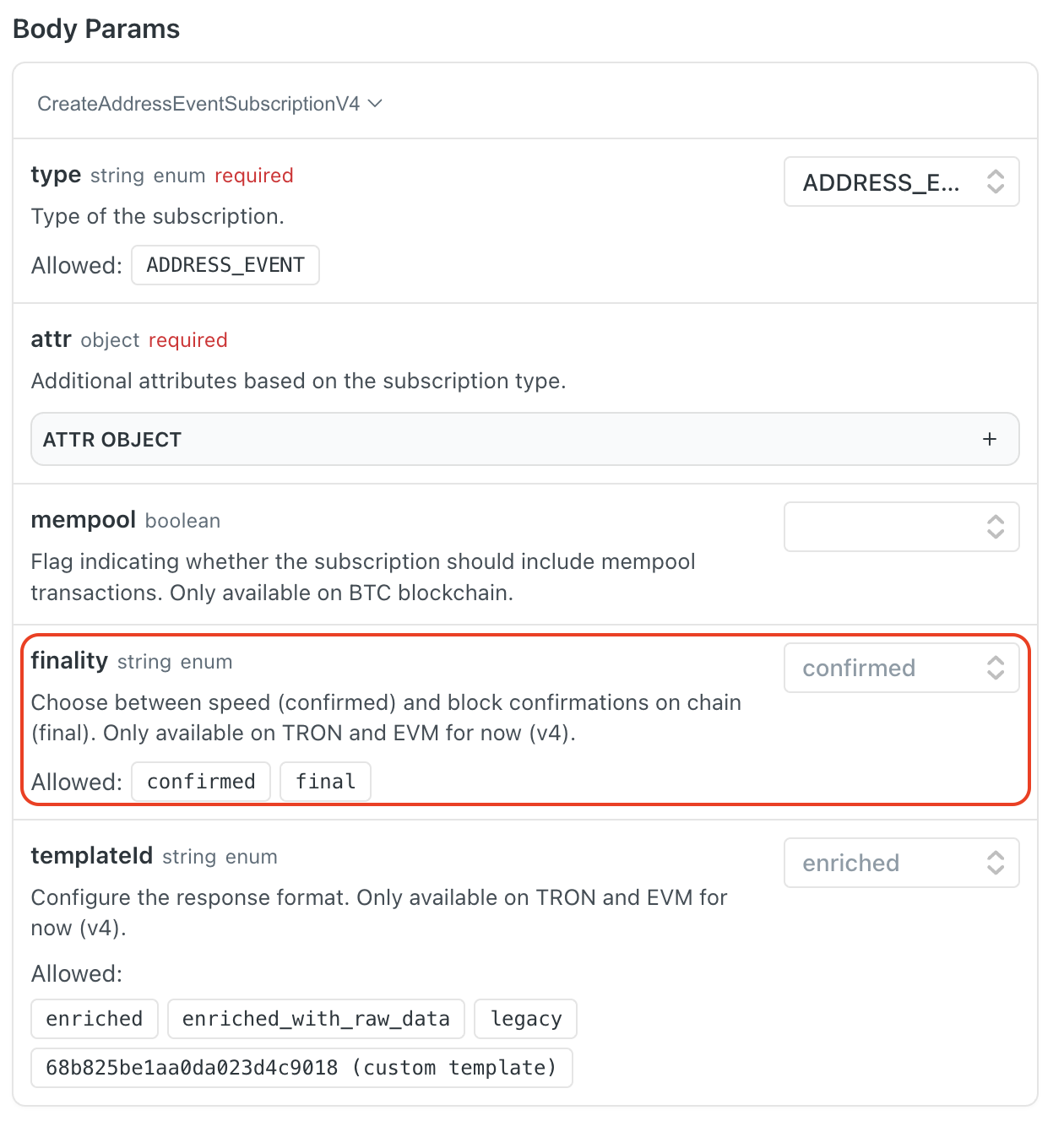
The finality parameter controls when a notification is dispatched relative to on-chain confirmation state.
Allowed values:
confirmed– Optimized for speed. The event is triggered once the transaction is confirmed on chain.final– Waits for full block confirmation depth before dispatching the notification.
Use confirmed when lower latency is preferred.
Use final when you need higher settlement confidence (e.g., payment settlement or treasury operations).
👉 Refer to the Create an Alert V4 reference to see how to use this functionality.
Templates
Templates control the structure and formatting of webhook payloads. If no template is specified, notifications are delivered using the legacy format. Tatum also provides a default enriched template, which returns normalized, structured, and token-aware payloads. You can also create and manage custom templates to fully control the shape of your webhook data.
👉 See the Templates documentation for details on creating, updating, and managing notification templates.
Conditions
Conditions allow you to define additional rules that must be met before a notification is sent.
If the defined conditions are not satisfied, the event is not dispatched to your webhook.
Conditions support field-based comparisons such as transaction value, sender address, recipient address, contract address, or token attributes.
👉 Refer to the Create an Alert V4 reference for the full schema and supported fields.
Example
"conditions": [
  {
    "field": "value",
    "operator": ">=",
    "value": "1" // 1 ETH (human-readable format)
  }
]Don't have an API key?
Sign up to Dashboard and create your API keys today.
Get higher limits and use debugging tools.
Updated 3 months ago