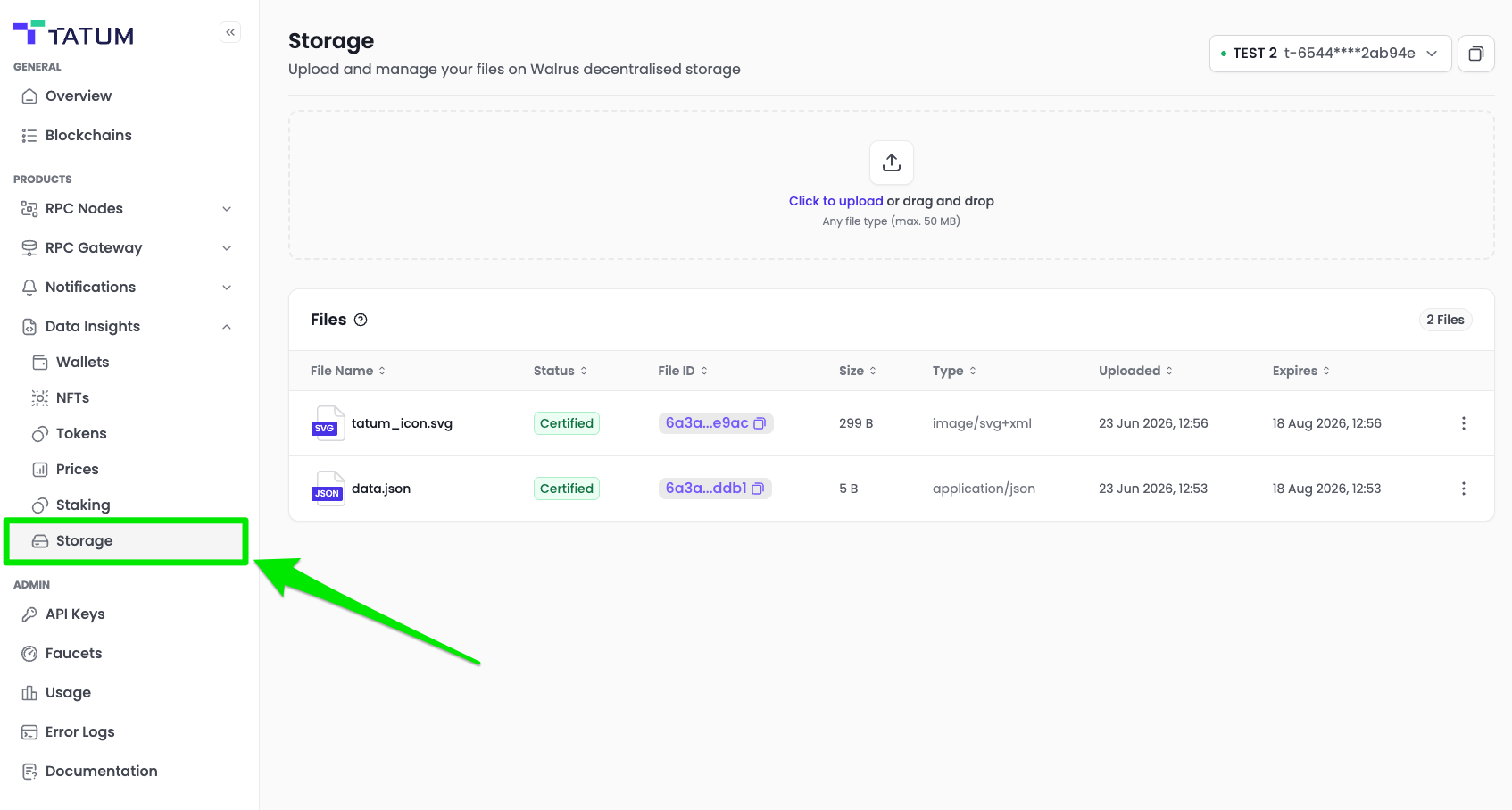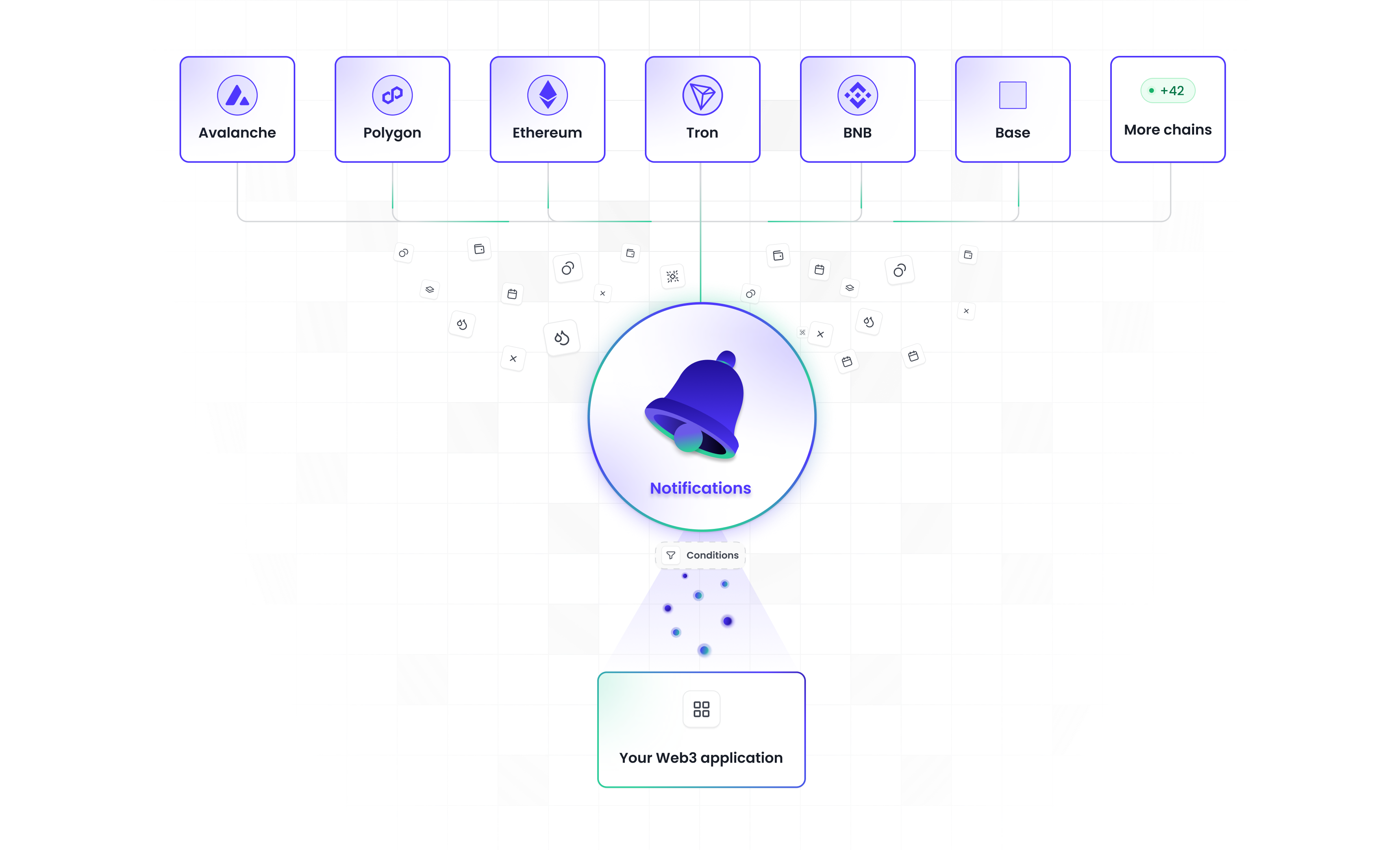

We’ve introduced Notifications Conditions & Filters to the Tatum Notifications system across all supported EVM chains and Tron. You can now define custom conditions that control when a webhook is triggered. This ensures you only receive notifications for relevant events, reducing unnecessary traffic and improving processing efficiency.

Blockchain Notifications

Receive alerts only when your defined conditions are met.

Why it matters

  • Reduce noise: filter out irrelevant events before they reach your system
  • Improve performance: process only meaningful data
  • Lower costs: minimize webhook volume and downstream processing

👉 Read more in the Notifications documentation - Conditions & Filters

Sui gRPC is available on Tatum for teams that want a faster, more structured, and type-safe way to access chain data than legacy JSON-RPC over HTTP. With Sui gRPC, you work with strongly typed Protocol Buffers request and response messages across ledger, state, Move package, name service, signature verification, and transaction execution methods. That makes Sui a strong fit for backends, indexers, explorers, wallets, and internal services that value predictable schemas, generated client code, and efficient binary transport.


Sui gRPC endpoint

↳ gRPC Mainnet
https://sui-mainnet-grpc.gateway.tatum.io
↳ gRPC Testnet
https://sui-testnet-grpc.gateway.tatum.io

What you get

  • Typed APIs: Sui gRPC exposes strongly typed Protobuf request and response messages across services such as LedgerService, MovePackageService, NameService, SignatureVerificationService, State methods, and TransactionExecutionService.
  • Smaller payloads: gRPC uses Protocol Buffers, which are generally more compact and structured than JSON.
  • Cleaner integrations: Generated gRPC clients reduce manual request building and response parsing across supported languages.
  • Good fit for backend workloads: Ideal for objects, transactions, checkpoints, balances, Move package metadata, SuiNS queries, signature verification, and transaction execution or simulation.
  • Live checkpoint streaming: Sui gRPC also supports real-time checkpoint subscription streaming through SubscriptionService.

The Sui Foundation has officially deprecated JSON-RPC. To ensure network performance and scalability, Tatum is transitioning the Sui infrastructure to a high-performance gRPC architecture.

Migration Path

To avoid service interruptions, please transition your applications to the new standard:

  • Primary Action: Follow our Sui gRPC Migration Guide.
  • Key Benefit: gRPC offers significantly lower latency and improved streaming capabilities compared to legacy JSON-RPC.
🚧

Attention

After the July 2026 End of Life date, JSON-RPC endpoints will be decommissioned and will no longer return data. We strongly recommend prioritizing this migration in your current development cycle.

We’re introducing the Tatum Liquid Staking API, enabling developers to retrieve liquid staking balances and supported staking pools across major staking ecosystems (Solana, Ethereum).

Liquid Staking APIs

📘

Get Liquid Staking Current Assets

GET /v4/data/staking/liquid/current-assets
Retrieve all liquid staking tokens held by a wallet address across supported liquid staking protocols.
Explore Docs →

📚

Get Liquid Staking Pools

GET /v4/data/staking/liquid/pools
Explore Docs →
Retrieve all supported liquid staking pools and tokens for a blockchain, including major protocols like Lido, Rocket Pool, Marinade, and Jito.

With the Liquid Staking APIs, developers can:

  • Detect liquid staking token balances held by wallets
  • Discover supported liquid staking protocols and pools
  • Build staking dashboards and portfolio trackers
  • Power wallets and DeFi analytics platforms

These APIs simplify building applications that surface liquid staking positions across Ethereum and Solana ecosystems. Read more about this feature on Tatum website - Staking APIs.

We’ve expanded the Tatum Staking API to support Ethereum, enabling you to retrieve staking data directly from Ethereum wallets and validators.

Try Staking API in Dashboard

Explore staking data directly in the Tatum Dashboard.

Search any wallet address to view active stakes, validator details, and rewards in one place.

Search any wallet address to view staking assets and rewards directly in the Tatum Dashboard.

Ethereum Staking API Support

These endpoints are now available for Ethereum, allowing you to track validator activity, rewards, and staking transactions.

📘

Get Current Staked Assets

GET /v4/data/staking/native/current-assets
Returns all current staked assets for a given Ethereum address, including active stake details.
Explore Docs →

📚

Get Current Staked Assets by Validator

GET /v4/data/staking/native/current-assets-by-validator
Explore Docs →
Returns staked assets grouped by validator, including delegated amounts and validator details.

📚

Get Staked Account Rewards

GET /v4/data/staking/native/rewards
Explore Docs →
Returns historical staking rewards for Ethereum staking accounts.

📚

Get Staking Transactions

GET /v4/data/staking/native/transactions
Explore Docs →
Returns staking-related transactions, including stake, withdraw, and validator interactions.

What you can build

With Ethereum staking support, you can:

  • Build Ethereum staking dashboards
  • Track validator performance and rewards
  • Power wallets and staking analytics tools

We’ve introduced configurable finality levels for subscriptions in the Tatum Notifications system across all supported EVM chains and Tron.

When creating a subscription, you can now choose when webhook notifications should be triggered:

  • confirmed – Faster notifications with minimal confirmations
  • final – Notifications only after full block finalisation

This allows developers to balance speed vs reliability depending on their application requirements.

📘

Create a subscription

POST /v4/subscription
Configure finality settings when creating your notification subscription.
Explore Docs →

Cosmos gRPC is available on Tatum for teams that want a more structured way to query chain data than plain JSON-based endpoints. Under the hood, Cosmos SDK modules expose Protobuf Query services, which means you work with strongly typed request and response messages instead of hand-rolling JSON payloads. That makes Cosmos a good fit for backends, indexers, and internal services that value predictable schemas, generated client code, and efficient binary transport.

📘

This is an important distinction from Solana Yellowstone gRPC: Cosmos gRPC is not a live event stream. It is designed for request-response queries, not subscriptions, and there are no streaming methods in this interface. If your use case is reading balances, delegations, validators, staking data, governance state, or other module-backed chain data with a typed API, Cosmos gRPC is the better framing.

Cosmos gRPC endpoint

↳ gRPC
https://cosmos-mainnet-grpc.gateway.tatum.io

What you get

  • Typed queries: Cosmos SDK modules expose Protobuf-based Query services, so request and response shapes are explicit.
  • Smaller payloads: gRPC uses Protocol Buffers, which are typically more compact than JSON.
  • Cleaner integrations: Generated gRPC clients reduce manual request building and response parsing across supported languages.
  • Good fit for backend reads: Ideal for balances, staking, governance, validators, and other module state queries.
  • REST parity when needed: Cosmos SDK can expose REST equivalents for gRPC query methods through gRPC-gateway.

Solana Yellowstone gRPC is live on Tatum. You can keep a single gRPC connection open to Mainnet and receive transactions, accounts, blocks, and slot updates as they happen, instead of hammering JSON-RPC on a timer.

Under the hood it follows the same Geyser-style streaming path many Solana operators already know. If your bot, indexer, or dashboard has been stuck waiting on poll intervals, this is the lane meant for you.

Solana Mainnet gRPC endpoint

Yellowstone gRPC (Mainnet)

↳ gRPC (Mainnet)
https://solana-mainnet-grpc.gateway.tatum.io

What you get

  • Speed: Push-style updates beat round-tripping the same RPC call every few hundred milliseconds.
  • Payload: Messages use Protocol Buffers, which tends to be lighter than JSON for this kind of volume.
  • Control: Subscribe to the account, slot, block, or transaction shape your product cares about.

Read next

Looking for broader Solana coverage on Tatum? See Tatum Solana.

Need an API key first? Use the Tatum Dashboard.

If you want to test it now, import the Solana Mainnet gRPC Postman collection.
Need to validate endpoint behavior under load, reconnects, and edge cases? We prepared test suite for validating Solana Yellowstone gRPC (Geyser) endpoints. Tests all RPCs, streaming subscriptions, and edge cases, then reports pass/fail. 👉 Try our Solana GRPC Test repository.

We are excited to share that, we've introduced Webhook Templates in the Tatum Notifications system across all supported EVM chains and Tron. Templates allow developers to control the structure and format of webhook payloads sent by Tatum.

Supported formats include Enriched, Custom templates, and more. Each template returns a templateId that can be attached to a subscription to shape the webhook response.

📘

Create a Template

POST /v4/subscription/template
Create a custom notification template and use its templateId when creating or updating subscriptions.
Explore Docs →

Learn more in the Templates API.

We are updating the default webhook notification payload format for accounts created after March 19, 2026.

📘

Note

Existing accounts remain unaffected. All subscriptions for users who created an account before March 19, 2026, will continue using the legacy format unless explicitly updated.

What's Changed

New accounts created after March 19, 2026 will automatically receive a restructured webhook payload with clearer, more explicit fields, including from, to, tokenMetadata, and additional transaction context. This is a non breaking change for existing response as they stay on the old default response.

Why this matters

The new format provides:

  • Explicit sender/recipient fields (from, to)
  • Structured token metadata
  • Additional transaction context (gas usage, timestamps, etc.)

Upgrading existing subscriptions

To switch an existing subscription to the new payload format, use the Update Subscription endpoint:

📘

Update a subscription

POST /v4/subscription/{id}
Configure conditions to trigger notifications only for relevant events.
Explore Docs →

Payload Comparison

Learn more about Templates.

FieldLegacyNew
Sender addressaddressfrom
Recipient addresscounteraddressto
Token infoLimitedFull tokenMetadata object
Gas detailsNot includedadditionalData.gasUsed, gasPrice

Example: New payload format

{
  "data": {
    "kind": "transfer",
    "blockHash": "0x1234567890abcdef...",
    "blockNumber": 18500000,
    "blockTimestamp": 1699123456,
    "txId": "0xabcdef1234567890...",
    "currency": "ETH",
    "txTimestamp": 1699123456,
    "from": "0x742d35Cc6634C0532925a3b8D4C9db96C4b4d8b6",
    "to": "0x8ba1f109551bD432803012645Hac136c",
    "value": "1000000000000000000",
    "contractAddress": "0xA0b86a33E6441b8c4C8C0C8C0C8C0C8C0C8C0C8C0C",
    "tokenId": "12345",
    "additionalData": {
      "gasUsed": "21000",
      "gasPrice": "20000000000"
    },
    "tokenMetadata": {
      "type": "nft",
      "decimals": 0,
      "symbol": "NFT",
      "name": "My NFT",
      "uri": "https://api.example.com/metadata/12345"
    },
    "subscriptionId": "64f1a2b3c4d5e6f7g8h9i0j1",
    "subscriptionType": "ADDRESS_EVENT"
  },
  "location": "...",
  "scheme": "..."
}